Why Your Customer Journey Ends Before a Sale Happens
Most business owners I meet think their problem is getting more leads. But when I sit with them and map out what actually happens after someone shows interest, we find a completely different problem. The leads are coming. The interest is there. But somewhere between 'I want to know more' and 'I am ready to pay,' the customer disappears. That gap — that invisible space between interest and purchase — is your customer journey. And for most Indian MSMEs, it is broken in at least three places.
Let me give you a real situation. A garment manufacturer in Tirupur was getting regular enquiries through Instagram. People would DM, ask for the catalogue, and then go silent. The owner assumed they were just price-shopping. But the actual problem was simpler. After sending the catalogue, there was no follow-up message, no next step, no clarity on how to order. The customer was genuinely interested but did not know what to do next. Nobody told them. The journey just stopped mid-air. This is more common than most founders admit.
A customer journey is not a fancy marketing diagram. It is simply this: the sequence of experiences a person goes through from the moment they first hear about you to the moment they pay you — and beyond. Most businesses only think about two moments: the first contact and the final sale. Everything in between is left to chance. And that 'in between' is where buyers make their decision. It is where trust is built or lost. It is where confusion creeps in and people quietly walk away.
Here is what a broken customer journey looks like in a typical Indian service business. Someone finds you on Google or Instagram. They check your profile or website and it looks decent. They send a WhatsApp enquiry. You reply with a price or a PDF. They say 'let me think about it.' You wait. Nothing happens. You follow up once, maybe twice. Then you move on. Sound familiar? The issue is not your price. The issue is that between their first message and your price quote, they had zero reason to feel confident that you were the right choice. The journey skipped all the trust-building steps.
There are usually four places where the journey breaks for MSMEs. First, the gap between discovery and contact — your profile or website does not give enough context for a stranger to feel safe reaching out. Second, the gap between enquiry and response — you take too long, or your first reply is a quote with no warmth. Third, the gap between proposal and decision — the buyer has no information to help them decide, and you have no process to guide them. Fourth, the gap after the first sale — you deliver the work, collect payment, and disappear. No check-in, no next conversation, no reason for them to come back. If you want to go deeper on diagnosing these gaps in your specific business, a one-to-one consultation is the fastest way to find exactly where your journey is breaking.
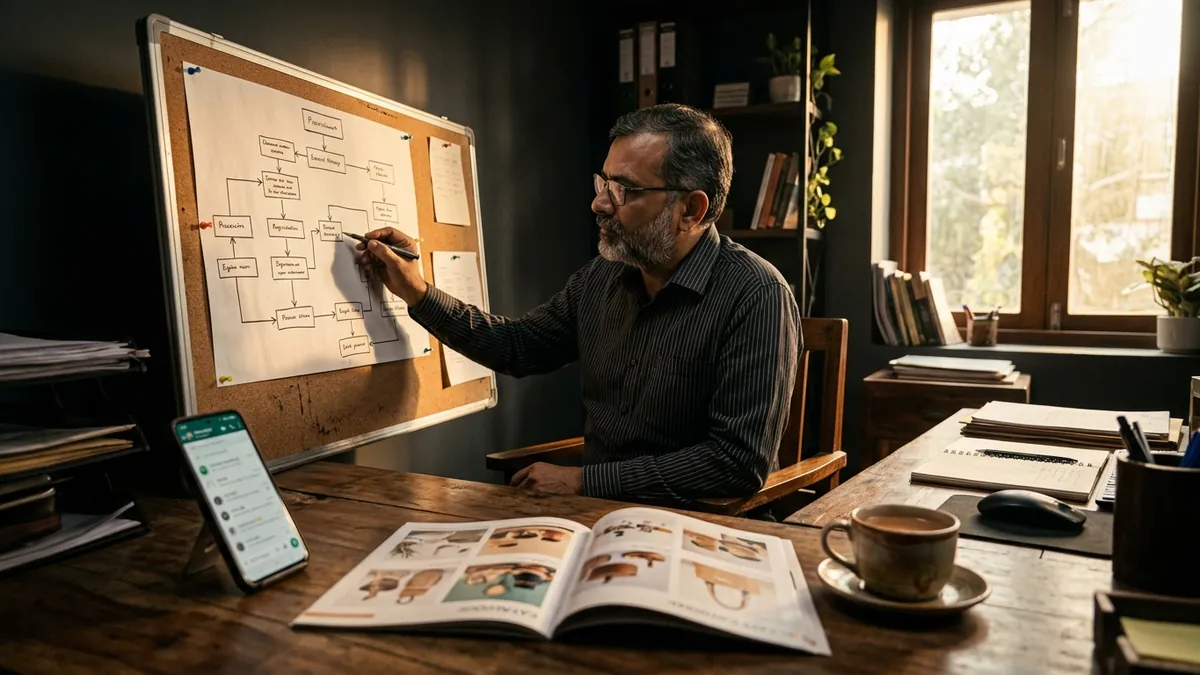
The fix does not require expensive software or a big team. It requires clarity and consistency. Start by writing down every step a customer takes from first hearing about you to making a repeat purchase. Be honest. Most founders discover that several steps are completely unplanned — they just happen however they happen on a given day. Once you see the full picture, you can identify the two or three places where people are falling off. Then you build a simple, repeatable response for each of those moments. A warm first reply. A clear next step after the catalogue goes out. A one-week follow-up message that feels human, not desperate. A post-delivery check-in that opens the door to the next conversation.
I have seen manufacturers, architects, boutique owners, and coaching businesses transform their conversion rates not by spending more on ads, but by simply fixing what happens after the first enquiry. One school supplies distributor I worked with was converting roughly 12 percent of his enquiries. After we mapped and fixed his journey — mostly just response speed, message clarity, and one follow-up step — his conversion moved above 30 percent in under two months. Same number of enquiries. More than double the business. If you want to learn how to apply this kind of thinking systematically, our business growth workshops walk through exactly this with real business examples.
One thing that quietly destroys the customer journey is assuming the buyer knows what to do next. They do not. At every single step, your job is to tell them the next action. Not in a pushy way — just clearly. 'Here is the catalogue. If you would like samples, here is how to request them.' 'We have sent the proposal. Would you like a 15-minute call to go over any questions?' 'Your order is delivered. Please let us know how it arrived. We would love to know if you need anything else.' These are not scripts. They are moments of clarity that keep the journey moving instead of stalling.
If your business is getting enquiries but not enough conversions, do not immediately blame your price or your product. Walk the journey yourself. Pretend you are a new customer who just found your business today. Send yourself a message and see what happens. How quickly does a reply come? How clear is it? What is the next step? Does it feel easy and trustworthy, or confusing and cold? Most founders are shocked by what they find. Fix the journey, and you fix the revenue. It really is that direct. If you want a second pair of experienced eyes on your business, you can always reach out and we can take a look together.
Want to understand where your business growth is stuck?
Book a Business Growth Diagnostic with Abhijit JK — an honest, focused 60-minute one-to-one session with Abhijit JK on your brand, website and growth.
Book a Business Growth Diagnostic