Why Your Business Has No Standard Sales Script
Most business owners I meet have never written down how to sell their own product or service. They rely on whoever is handling the enquiry to figure it out. One person is confident and closes well. Another fumbles and drops the price immediately. A third sends a quote without even understanding what the buyer actually needs. The result is not a sales problem — it is a consistency problem.
I have seen this across manufacturing units, clinics, retail stores and service agencies. The founder knows the business deeply. But that knowledge stays in their head. The moment an enquiry reaches a sales executive, a front desk person or a WhatsApp account managed by a junior, the pitch falls apart. Buyers sense it. They hesitate. They say they will think about it. And they rarely come back.
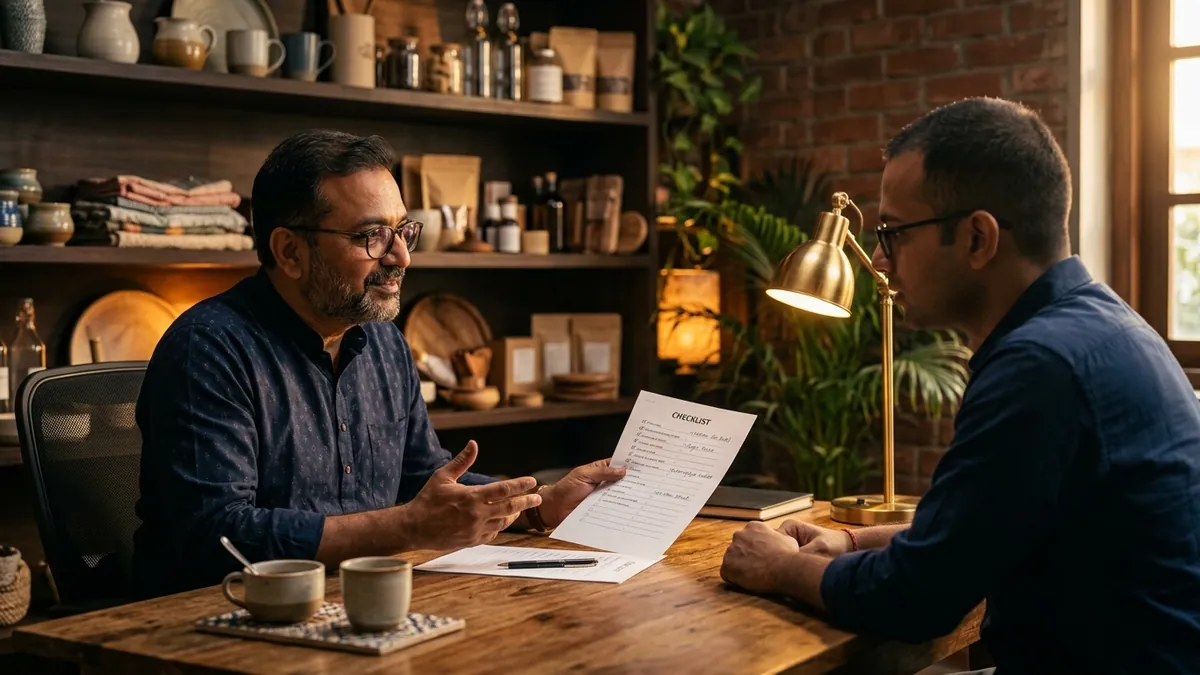
A sales script is not a rigid robotic speech. Think of it as a structured conversation guide. It tells your team what to say first, what questions to ask the buyer, what to highlight about your offer, and how to handle the three most common objections you face every week. When I work with founders through a one-to-one consultation, creating this script is often one of the first things we build together — because without it, every other marketing effort leaks at the final step.
Start by writing down the five most common questions your buyers ask before they make a decision. Not the fancy ones — the real ones. 'What is the price?' 'How long does delivery take?' 'Do you give a warranty?' 'Can I see samples?' 'Why should I choose you over the competitor down the road?' Your script needs clean, confident answers to all of these. If your team cannot answer these consistently, you are losing sales you should be winning.
Next, map the structure of a good first conversation. Most good sales conversations follow a simple flow: greet and build comfort, ask one or two genuine questions about what the buyer needs, present the most relevant part of your offer, address concerns, and close with a clear next step. That next step is not 'I will send you a quote.' It is 'Can I confirm this for you by Thursday?' or 'Shall I block a slot for a site visit?' Buyers need to be led — not left to decide alone.
The objection section of your script is where most businesses give up the most money. When a buyer says 'your price is too high,' most untrained salespeople either discount immediately or go silent. Your script should have a calm, practiced response ready. Something like: 'Most of our clients said the same thing before they saw the full value of what we deliver. Let me show you what is included.' You do not need to be aggressive. You need to be prepared. If you want to sharpen this as a team, our business growth workshops cover live objection-handling practice that sticks.
One thing founders often overlook is the opening line. How does your team pick up the phone or reply to a WhatsApp enquiry? 'Hello, yes tell me' is not a sales opening. It signals that you are just waiting to hear what the buyer wants rather than actively guiding the conversation. A better opening might be: 'Thanks for reaching out. I would love to understand what you are looking for so I can find the best option for you.' It is a small shift — but it changes the entire tone of the call.
Once you have a draft, test it. Have your team use it for two weeks on real enquiries. Record calls where possible. Notice where buyers lose interest or ask questions your script did not prepare for. Update it. A sales script is a living document — not something you write once and forget. The best businesses I have worked with treat their script the same way they treat their product: they keep improving it based on real feedback from real buyers.
If you are a founder still handling most enquiries yourself, the script still matters — because the day you hire someone or go on leave, your sales should not collapse. Building the script now is building a system. And systems are what turn a founder-dependent business into one that can grow without you standing in the middle of every sale. That is the shift worth working towards. If you want to get started, contact me and we can put together something specific to your business and your buyers.
Want to understand where your business growth is stuck?
Book a Business Growth Diagnostic with Abhijit JK — an honest, focused 60-minute one-to-one session with Abhijit JK on your brand, website and growth.
Book a Business Growth Diagnostic

