Why Your Website Gets Traffic But Zero Enquiries
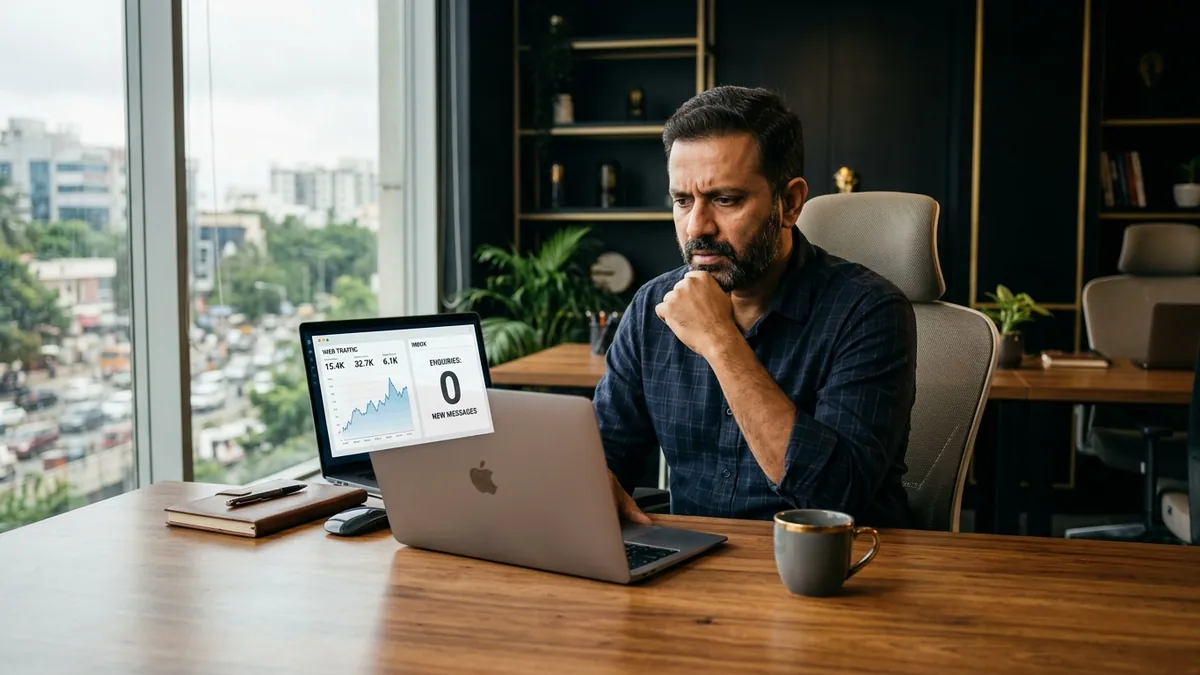
Most business owners I meet are proud that their website exists. They paid someone to build it. It looks clean on mobile. Google Analytics shows 300 to 800 visitors a month. But when I ask how many enquiries came through the website last month, there is a long pause. Usually the answer is two or three. Sometimes zero. And they have been living with this for a year or more without questioning it.
Traffic without enquiries is not a traffic problem. It is a conversion problem. There is a difference, and confusing the two is expensive. Chasing more SEO or more ads to bring in more visitors will not fix a website that is structurally unable to convert. You need to diagnose the right problem first. I have seen manufacturers in Pune, retailers in Coimbatore and service businesses in Bengaluru make this same mistake repeatedly — throwing more money at Google Ads while the actual issue sits inside the website itself.
The first reason visitors leave without enquiring is a mismatch between what they expected and what they found. Someone searches 'industrial packaging supplier Hyderabad' and lands on your homepage which talks about your company history from 2003 and your ISO certificate. That visitor was ready to enquire. Your page was not ready to receive them. The entry point needs to match the search intent. If someone lands on a generic homepage after clicking a specific search result, most of them will leave within 15 seconds. I have audited websites where every single page had the same headline — the company name and tagline — with no context for what the visitor was looking for.
The second reason is a weak or invisible call to action. Not a missing button — most websites have a 'Contact Us' link somewhere. I mean a reason to act right now. 'Contact Us' is not a reason. 'Get a Free Sample Pack Delivered to Your Office' is a reason. 'Tell Us Your Requirement and Get a Quote in 24 Hours' is a reason. Buyers in India, especially B2B buyers, are cautious. They are wondering if you are legit, if you will respond quickly, if this is worth their time. A call to action that answers those worries converts far better than one that just says 'reach out to us'. If you want to work through exactly what your website's conversion gap looks like, a one-to-one consultation is often the fastest way to get that clarity.
The third reason is that the website talks about the business, not the buyer's problem. I wrote about this pattern separately. Here it is shows up again specifically in conversion. Your visitor arrives with a problem. A load of ceiling fans to source. A factory audit to pass. A launch event to plan. They scan your website looking for one thing: proof that you understand their problem and have solved it before. Instead they see your founding year, your team photo and a long paragraph about your 'commitment to excellence'. That does not convert. What converts is specificity. A case study. A number. A before-and-after. Proof that someone like them got results from you.
Page speed and mobile experience still kill conversions in India far more than people admit. I am not talking about a website that takes 12 seconds to load. Even a four to five second delay, on a slow 4G connection in a tier-two city, loses a significant percentage of visitors before the page finishes loading. Pull up your website on an Android phone on a normal mobile connection, not your office Wi-Fi. See what your buyer actually sees. Check Google PageSpeed Insights for free. If your score is below 60 on mobile, that is a serious conversion leak. Most websites I audit built on older WordPress themes or with heavy sliders fail this test badly.
Trust signals are either missing or placed wrong. In India, buyers are skeptical of websites they have not heard of before. They want to see that real people and real businesses have worked with you. Logos of clients you have served. A GST number visible somewhere. An actual address, not just a contact form. A phone number they can click and call. Real photos of your team or facility, not stock images of people in suits shaking hands. These elements do not make a website look old-fashioned. They make it feel safe to enquire. I regularly see businesses spend lakhs on a visually polished website and then wonder why it does not convert — and the answer is simply that the buyer does not trust it yet.
Finally, most websites have no follow-through path for the visitor who is interested but not ready to enquire today. That visitor leaves and you have no way to reach them again unless they remember to come back. A simple lead magnet — a product catalogue PDF, a checklist, a short guide relevant to your buyer — gives them a reason to share their email. Then you have a way to stay in their consideration until they are ready. This does not need a complex marketing automation system. It can start with a Google Form and a manually sent email. The point is to capture the interest before it walks away. If you want to see how other business owners in your category are approaching this, the business growth workshops cover practical website conversion alongside other growth levers.
Getting traffic is the beginning, not the result. If your website has been sitting at 300 to 500 visitors a month and producing one or two enquiries, do not add more traffic. First, fix what is already breaking. Audit the landing experience. Sharpen the call to action. Add proof. Speed up the mobile load. Build a trust layer. These are not big redesign projects. Most can be done in two to four weeks with your existing website. Start this month with one fix — look at your most visited page and ask yourself honestly: if I landed here as a stranger with a real problem, would I enquire? That answer will tell you everything.
Want to understand where your business growth is stuck?
Book a Business Growth Diagnostic with Abhijit JK — an honest, focused 60-minute one-to-one session with Abhijit JK on your brand, website and growth.
Book a Business Growth Diagnostic